Friday, April 22, 2011

Easter pastieri


In a previous post I mentioned how pastieri is one of my favourite Easter dishes to make simply because it's so easy. This dish was passed down to me from my Calabrese Nonna Filomena. Other than our family, I've never seen it made by anyone else. 

Mix all ingredients together before baking.

In Naples they make something called pastiera, which is completely different from our recipe. Go to the Napoli Unplugged blog for a mouth-watering collection of recipes. The Sicilians make a pastieri but it's a stuffed pastry, which looks fantastic, but still not like ours.

From what I've been told, after immigrating to North America, my Nonna's cooking was greatly influenced by her Neapolitan sister-in-law who was a wonderful cook. Could this be where the name came from? I'm guessing this recipe is a combination of influences of Italian immigrants from other regions, along with the availability of ingredients in a small city at the time they immigrated. 

Whatever the reasons, it's a lovely food tradition that finds its way onto the table at family reunions reminding us of how we're connected.
If you've made pastieri or recognize this dish, please leave me a comment. If you try this for the first time, let me know about it. 

Cut in rectangles and serve cold. Eat with your hands.

The recipe

Pastieri makes an interesting addition to an Easter Brunch. It keeps well in the fridge, making it a good prepare-ahead dish.

  • Cook 1 lb (or 500 g) linguini in salted water. Once cooked, rinse in cold water to cool (so it won't cook the eggs when they’re mixed together). Drain well.
  • Beat 1 dozen eggs
  • Add:
- Ricotta, 1 container (16-ounce or 500 gram)
- Grated cheese, 1 cup or more of parmesan, use romano if you like a stronger cheese
- Italian parsley, chopped, 1 bunch or 1/2 cup (to your liking)
- Black pepper, to taste

  • Mix all ingredients together and let rest for about 20 minutes.
  • Pour into a greased 9x13 baking pan. Press down on the pasta mixture with your hands (to get the air out) and smooth the top.
  • Bake at 350°F for 1 hour.
  • Remove from oven and cool.
  • Serve cold, cut into rectangular pieces. Eat with your hands.
    Enjoy!


    Wednesday, January 12, 2011

    Earthquake/Terremoto: Fragments from Calabria


    Earthquake. Terremoto. It’s in my blood. As far back as I can remember earthquakes have been part of my family’s lore from Calabria, Italy. 

    When I first heard of the devastating earthquake in the Abruzzo region of Italy in April 2009, my heart stopped. The first beat it missed was for family and friends who might be in harm’s way. The second beat it missed was for the people who lost everything including their lives. And in place of the third beat my heart missed was a replay of all the stories of terremoto that have passed through many generations before reaching me.
     
    In the years following the Abruzzo earthquake there have been equally and more devastating quakes: Haiti, Chile, China. Images of lost lives and landscape circled the globe. Today marks the one-year anniversary of the worst of recent quakes, the death of over 300,000 in Haiti.
     
    With each subsequent quake, the fragments of earthquake stories handed down to me surfaced. Here are some of those fragments.
     
    Grimaldi in the 1600s
     
    In the early 1600s a powerful earthquake destroyed Grimaldi, the Cosentine village of my nonni. In southern Italy, tens of thousands of lives were lost. In Grimaldi, the oral tradition says, only five families survived, including my ancestors. According to the story carried by my Nonna, an old man came to the town and sat on rock. He told the remaining families to rebuild Grimaldi in a new location and they would be saved from future devastation. After this proclamation, the man suddenly disappeared. The story claims that this old man was God (Dio) sent to save them with his message. If you’re from Calabria, who else could it be.

    In 1638, the original "Grimaldo" was destroyed by an earthquake, and the town was rebuilt in an area known as “Chiata” (from where the district "'mpedichiati" developed, meaning literally "at Chiata's feet"). In 1639 the rebuilding of the original Grimaldi began ("vecchio Grimaldo").

    Source: http://dic.academic.ru/dic.nsf/enwiki/3165462
    The survivors built a new Grimaldi in the shape of a cross. You can still see the basic cross shape, which has bloated with more modern developments. Here’s my photo of Grimaldi in 2008:

    Grimaldi

    February 1783

    A hundred years after rebuilding Grimaldi to the specifications of Dio, the people of Grimaldi were saved from the 1783 earthquake that killed over 80,000 Calabresi. 

    In 1934, my Nonna Elvira wrote the 1783 earthquake story recited to her by her nonna Caterina (who was really her great-aunt, but that’s another story). What I found interesting from my nonna’s story is that her nonna recited it in Calabrese but because Nonna Elvira hadn’t been taught how to write Calabrese in school, she translated it into Italian. Was that because of Unification (1861) and the introduction of an “official” Italian language? I’d love to hear your wisdom on the demise and resurgence of the written Calabrian language(s).

    Here’s an excerpt from Nonna’s translation about the destruction of the many towns around Cosenza during an icy February, and the salvation of the Grimaldesi. The story is over three pages long and reads like a poem or a prayer:

    Che terrore, e che gran lutto,
    Fra i ghiacci de febraio.
    Oh! Iddio, che cosa amara, e che malanno
    Mura, e travi, a nostro d’anno
    Contrastava cosi forte
    Che vidiamo la morte e noi d’avanti
    E Cosenza con i tanti
    Case e torre del suo valle
    Senti quel triste ballo con gran duolo
    Ne quel pianto, ne fu solo
    Rende, Donnici, e Marano,
    Paterno di Pigano, e Mendicino
    Cerisano del la vicino
    Caroleir, Casello, Franco
    Dal cielo era quasi stanco, aveva distrutto
    E per questi luoghi tutti
    Da vicino, e da lontano
    Non ce paesa sano afatto afatto
    Ma Grimaldi e tutto sana
    Financo da lontano, a da vicino,
    Che divina maraviglia
    Di quei nostri cittadini
    Trovati a quei confini si salvarono
    E il miracolo contrarono...
    The story lists places destroyed by the earthquake, except Grimaldi “e tutto sana” -- it’s whole. For a crude translation, go to Google translate.

    The 1783 earthquake changed the landscape of the south, cracking open its shell and producing hundreds of lakes. The violence of the earthquake itself was not the only killer. Tens of thousands died from malaria in the years following the quake. I like to think that’s partly why we’re short, brown people and not tall blondies. 

    1905: Boyhood recollections from Bocchigliero
     
    In 1965 my great-uncle Charlie wrote a wonderful memoir. I’m lucky to have a copy, which is one of my cherished possessions. Uncle Charlie was a young boy in Calabria when the earthquakes of the early twentieth century hit. Here’s his 1905 boyhood recollections from Bocchigliero, another of my ancestral villages:

    “I can still remember quite vividly the earth tremors in our home town.... Most of the people in our town were ordered to vacate their homes (including us) and we camped out of town in a large orchard for more than three weeks. ...there were many houses in our town with extensive damage....”

    Strait of Messina, 1908

    On December 28, 1908, a massive earthquake struck Sicily and Calabria. As part of his military service, my Nonno Joe was sent to the earthquake zone to help with the rescue efforts. He earned a medal for rescuing a woman trapped beneath the rubble of her destroyed home. The estimated death toll for this earthquake was as high as 200,000.

    Here is Nonno’s medal along with an excerpt of the accompanying paper work: 

    Medaglia commemorativa. Terremoto Calabro-Siculo. 28 dicembre 1908.


    The Italian video below marks the 100th anniversary of the 1908 earthquake:


    These are a few of the earthquake fragments that make up my whole. More to come.

    Tuesday, December 14, 2010

    10 things I like about Mexico

    A recent trip to Playa del Carmen, Mexico, was the perfect place to escape from the snow-dusted streets of home. There are lots of things I like about Mexico, particularly when it's winter in Canada. Here are the 10 favourites from my recent trip.

    1. Frida Kahlo sells everything

    Negra Modelo beer with Frida label


    2. The beach is beautiful and not just for beach bunnies
    Lunch stop at Zamas

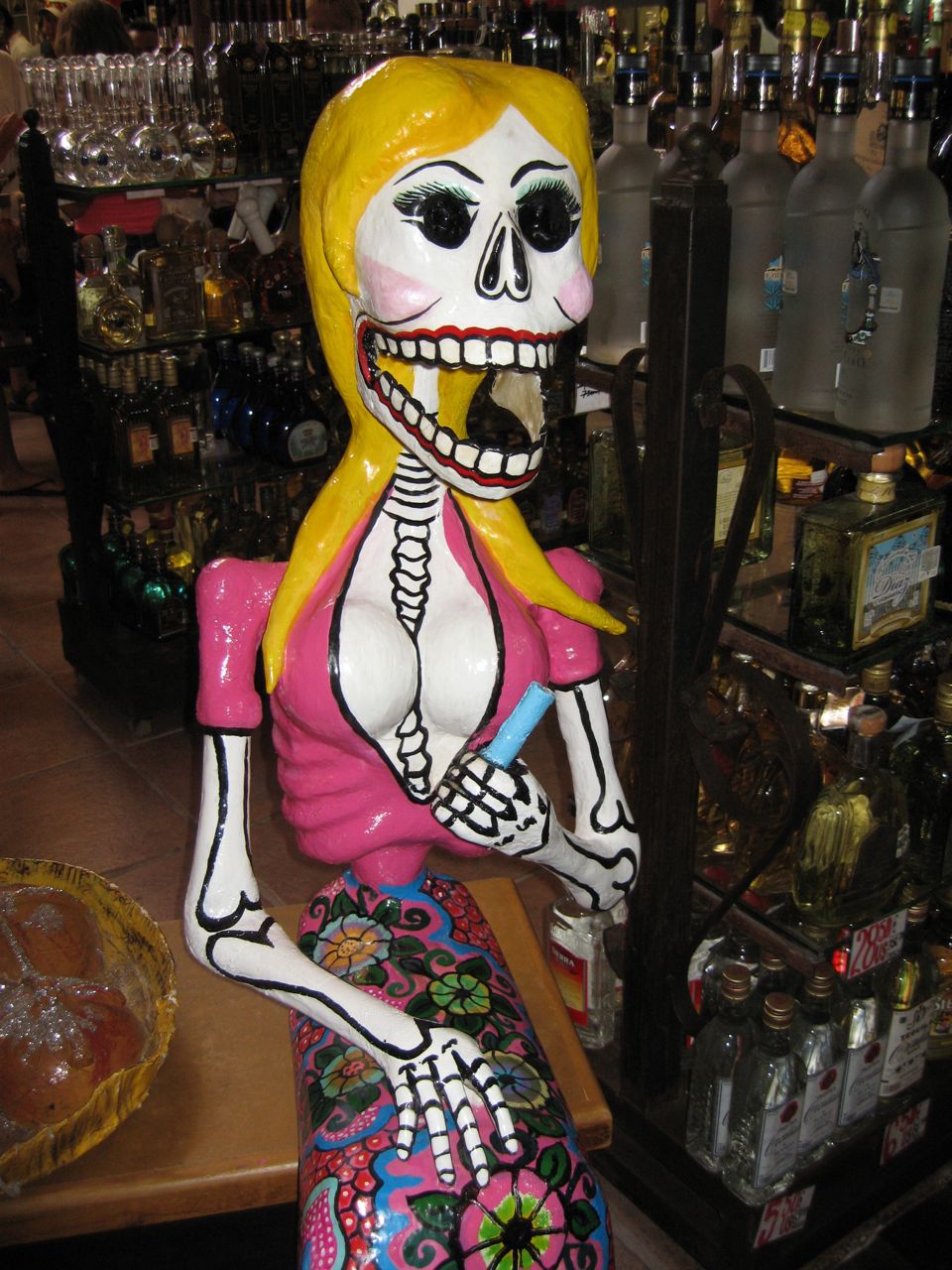
    3. Skeletons with boobs

    Day of the Dead attraction at a tourista shop

    4. Bicycle parking in the jungle

    At the Mayan ruins of Coba

    5. Iguanas and other animals we don't have at home

    Iguana at Tulum

    6. Really old and historic stuff like Mayan ruins

    Chichen Itza: sculls with Temple of Kukulkan (El Castillo) in the background

    7. Real tacos and tequila drinks
    Fresh lime margarita with achiote shrimp tacos at Zamas

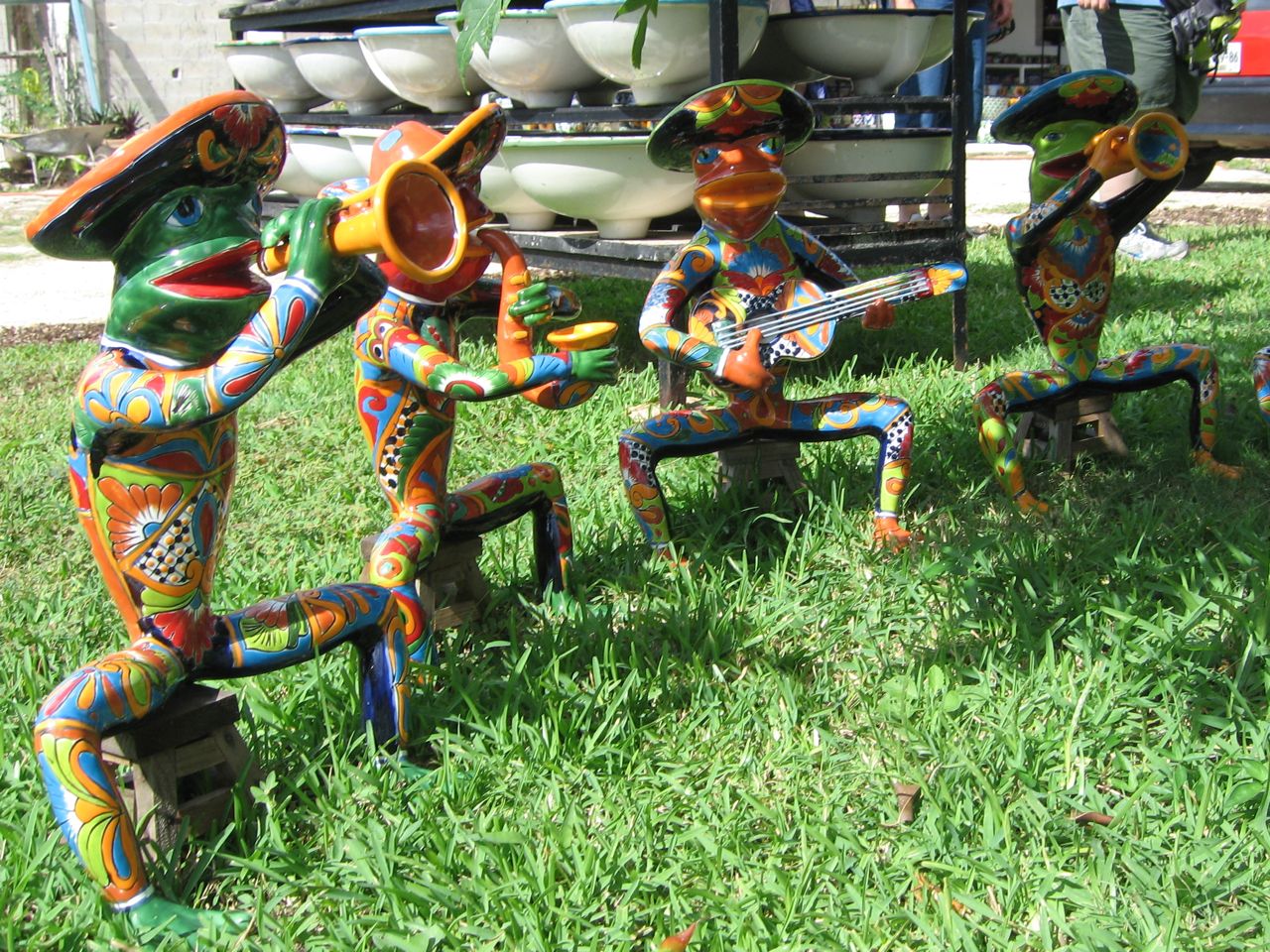
    8. Mariachi music and talavera pottery


    Talavera pottery frogs playing mariachi music (use your imagination)
    9. Brightly coloured buildings

    Valladolid, Yucatan
    10. Fresh coconuts. Everywhere.

    Our home in Playcar

    What are your favourite things about Mexico?

    Tuesday, December 7, 2010

    Beauty and death


    I was saddened to hear of the construction worker who died of his injuries from falling off the Canada Place sails in Vancouver. I watched the workers in August, appearing as ants against the massive white sail structure they were repairing. I have the greatest respect for workers who could do that kind of job so high off the ground, exposed to the elements, and often in plain view of a crowd of tourists. The photos below show the scale of their work. RIP.


    (Click photos to enlarge.)


    Saturday, October 30, 2010

    Mushroom (funghi) memories


    I don't know of anyone who has a middle ground position on mushrooms. You either love them or you hate them. I love them.

    While digging out dandelions and mushrooms from the garden, thinking I should be making a nice insalata with them, I realized I had no idea how to pick a "safe" mushroom. The backyard mushroom yield reminded me that two years ago we were in Calabria during funghi season.


    On our way to Bocchigliero, we stopped for lunch at La Tavernetta, an upscale restaurant outside of Camigliatello Silano, which is a charming ski resort with small shops selling the wonderful old-world foods Nonna Filomena used to make.

    La Tavernetta specializes in local foods including fungi Silani. We savoured shaved porcini in olive oil while watching gigantic mushrooms being brought into the restaurant's kitchen.


    After a very expensive but fabulous lunch, we returned to the winding road and forests of the Sila. We kept seeing guys smoking cigarettes, leaning against their trucks with a scale and basket on the ground. They were waiting to buy the haul from mushroom harvesters.

    We decided to make our own trek into the forest in search of prized mushrooms. It was easy pickings rummaging though leaves and around tree roots. Sadly we had no idea what was edible and what was poisonous. I wished my Uncle Nick was with us.


    For me, Uncle Nick is synonymous with mushrooms. One of my fondest childhood food memory is eating his amazing marinated mushrooms. Sadly, Uncle Nick died last month. I will never know his secret and I'm sure I'll never taste mushrooms like that again.

    Wednesday, September 29, 2010

    Happy Birthday Nonno


    Although my Nonno Tony lived into his nineties, he didn't make it as far as today, which marks his 99th birthday. Ninety-nine years.


    His mother carried him during the time of cholera epidemics in southern Italy. She was later taken by the 1918 Spanish influenza pandemic.


    Italy, as a country, was only 50 years old. As was Italian as the official language, an adaptation of the Tuscan dialect, and the language of Dante.


    In 1911, L'Inferno, an adaptation of Dante's Inferno was the first full-length Italian feature film ever made. It was a silent film, which wasn't shown in Nonno's town. When he was born, there was no electricity in town. Today, you can watch the YouTube version on your phone.


    The world has seen much change since the days of Nonno's youth and life in his small Calabrese town. Today I remember his journey and his life.


    Sunday, September 19, 2010

    What I did on my summer vacation


    I've neglected this blog for far too long. If you've come back, I thank you so much for your patience. Now that fall is approaching I will dedicate more time to keeping up to date. In the meantime here are some snippets of things I've seen or done over the past four months, or "what I did on my summer vacation."


    On the outskirts of El Paso, I fell in love with fresh fruit popsicles at Flautas y Paleteria Tepalca in Canutillo, Texas. When I say fresh, mmmm, I can't come close to describing how deliciously orgasmic they were. Take a look at the pinons in the creamsicle below; then I went back for mango. This was an unusual discovery due to road work on the Interstate but it will now be a regular stop on my trips to that part of the US.


    I saw a sonoran gopher snake and heard coyotes howl in the desert of southern New Mexico.


    I found a metal tray decorated with actual hotel stickers. Not a replica. Not massed produced. The real deal. Looks like someone had a better summer vacation than I did, 60 years ago.


    I discovered more treasures amongst the wonderful things that were once my Nonna Elvira's. Here's a carefully preserved stencil that she used as a pattern for her cutwork linens.


    On a quick trip to Nelson, BC and a lovely walk along the lake, I came across a playground for adults fitted with outdoor fitness equipment. Best of all, t's FREE.


    In Vancouver, the BC Place stadium roof deflated and the new retractable roof is under construction.


    In keeping with the roof theme, the Canada Place (convention centre) roof is being "rehabilitated." Looks like a hazardous job.


    I went to Alaska and saw humpback whales bubble net feeding. A humbling experience.


    And, finally, while the weather is still nice, this is my favourite coffee place.


    While I'm having my coffee please leave a comment letting me know what you'd like to hear more about.


    Ciao.