Showing posts with label calabria. Show all posts

Wednesday, January 12, 2011

Earthquake/Terremoto: Fragments from Calabria


Earthquake. Terremoto. It’s in my blood. As far back as I can remember earthquakes have been part of my family’s lore from Calabria, Italy. 

When I first heard of the devastating earthquake in the Abruzzo region of Italy in April 2009, my heart stopped. The first beat it missed was for family and friends who might be in harm’s way. The second beat it missed was for the people who lost everything including their lives. And in place of the third beat my heart missed was a replay of all the stories of terremoto that have passed through many generations before reaching me.
 
In the years following the Abruzzo earthquake there have been equally and more devastating quakes: Haiti, Chile, China. Images of lost lives and landscape circled the globe. Today marks the one-year anniversary of the worst of recent quakes, the death of over 300,000 in Haiti.
 
With each subsequent quake, the fragments of earthquake stories handed down to me surfaced. Here are some of those fragments.
 
Grimaldi in the 1600s
 
In the early 1600s a powerful earthquake destroyed Grimaldi, the Cosentine village of my nonni. In southern Italy, tens of thousands of lives were lost. In Grimaldi, the oral tradition says, only five families survived, including my ancestors. According to the story carried by my Nonna, an old man came to the town and sat on rock. He told the remaining families to rebuild Grimaldi in a new location and they would be saved from future devastation. After this proclamation, the man suddenly disappeared. The story claims that this old man was God (Dio) sent to save them with his message. If you’re from Calabria, who else could it be.

In 1638, the original "Grimaldo" was destroyed by an earthquake, and the town was rebuilt in an area known as “Chiata” (from where the district "'mpedichiati" developed, meaning literally "at Chiata's feet"). In 1639 the rebuilding of the original Grimaldi began ("vecchio Grimaldo").

Source: http://dic.academic.ru/dic.nsf/enwiki/3165462
The survivors built a new Grimaldi in the shape of a cross. You can still see the basic cross shape, which has bloated with more modern developments. Here’s my photo of Grimaldi in 2008:
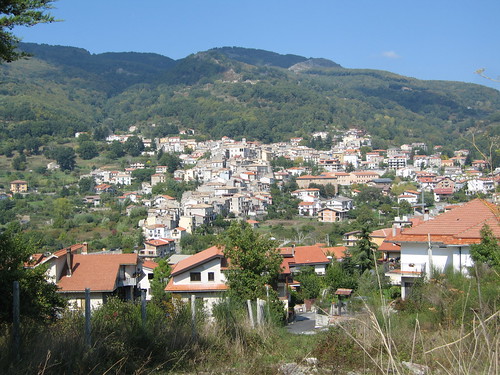
Grimaldi

February 1783

A hundred years after rebuilding Grimaldi to the specifications of Dio, the people of Grimaldi were saved from the 1783 earthquake that killed over 80,000 Calabresi. 

In 1934, my Nonna Elvira wrote the 1783 earthquake story recited to her by her nonna Caterina (who was really her great-aunt, but that’s another story). What I found interesting from my nonna’s story is that her nonna recited it in Calabrese but because Nonna Elvira hadn’t been taught how to write Calabrese in school, she translated it into Italian. Was that because of Unification (1861) and the introduction of an “official” Italian language? I’d love to hear your wisdom on the demise and resurgence of the written Calabrian language(s).

Here’s an excerpt from Nonna’s translation about the destruction of the many towns around Cosenza during an icy February, and the salvation of the Grimaldesi. The story is over three pages long and reads like a poem or a prayer:

Che terrore, e che gran lutto,
Fra i ghiacci de febraio.
Oh! Iddio, che cosa amara, e che malanno
Mura, e travi, a nostro d’anno
Contrastava cosi forte
Che vidiamo la morte e noi d’avanti
E Cosenza con i tanti
Case e torre del suo valle
Senti quel triste ballo con gran duolo
Ne quel pianto, ne fu solo
Rende, Donnici, e Marano,
Paterno di Pigano, e Mendicino
Cerisano del la vicino
Caroleir, Casello, Franco
Dal cielo era quasi stanco, aveva distrutto
E per questi luoghi tutti
Da vicino, e da lontano
Non ce paesa sano afatto afatto
Ma Grimaldi e tutto sana
Financo da lontano, a da vicino,
Che divina maraviglia
Di quei nostri cittadini
Trovati a quei confini si salvarono
E il miracolo contrarono...
The story lists places destroyed by the earthquake, except Grimaldi “e tutto sana” -- it’s whole. For a crude translation, go to Google translate.

The 1783 earthquake changed the landscape of the south, cracking open its shell and producing hundreds of lakes. The violence of the earthquake itself was not the only killer. Tens of thousands died from malaria in the years following the quake. I like to think that’s partly why we’re short, brown people and not tall blondies. 

1905: Boyhood recollections from Bocchigliero
 
In 1965 my great-uncle Charlie wrote a wonderful memoir. I’m lucky to have a copy, which is one of my cherished possessions. Uncle Charlie was a young boy in Calabria when the earthquakes of the early twentieth century hit. Here’s his 1905 boyhood recollections from Bocchigliero, another of my ancestral villages:

“I can still remember quite vividly the earth tremors in our home town.... Most of the people in our town were ordered to vacate their homes (including us) and we camped out of town in a large orchard for more than three weeks. ...there were many houses in our town with extensive damage....”

Strait of Messina, 1908

On December 28, 1908, a massive earthquake struck Sicily and Calabria. As part of his military service, my Nonno Joe was sent to the earthquake zone to help with the rescue efforts. He earned a medal for rescuing a woman trapped beneath the rubble of her destroyed home. The estimated death toll for this earthquake was as high as 200,000.

Here is Nonno’s medal along with an excerpt of the accompanying paper work: 

Medaglia commemorativa. Terremoto Calabro-Siculo. 28 dicembre 1908.


The Italian video below marks the 100th anniversary of the 1908 earthquake:


These are a few of the earthquake fragments that make up my whole. More to come.

Saturday, October 30, 2010

Mushroom (funghi) memories


I don't know of anyone who has a middle ground position on mushrooms. You either love them or you hate them. I love them.

While digging out dandelions and mushrooms from the garden, thinking I should be making a nice insalata with them, I realized I had no idea how to pick a "safe" mushroom. The backyard mushroom yield reminded me that two years ago we were in Calabria during funghi season.


On our way to Bocchigliero, we stopped for lunch at La Tavernetta, an upscale restaurant outside of Camigliatello Silano, which is a charming ski resort with small shops selling the wonderful old-world foods Nonna Filomena used to make.

La Tavernetta specializes in local foods including fungi Silani. We savoured shaved porcini in olive oil while watching gigantic mushrooms being brought into the restaurant's kitchen.


After a very expensive but fabulous lunch, we returned to the winding road and forests of the Sila. We kept seeing guys smoking cigarettes, leaning against their trucks with a scale and basket on the ground. They were waiting to buy the haul from mushroom harvesters.

We decided to make our own trek into the forest in search of prized mushrooms. It was easy pickings rummaging though leaves and around tree roots. Sadly we had no idea what was edible and what was poisonous. I wished my Uncle Nick was with us.


For me, Uncle Nick is synonymous with mushrooms. One of my fondest childhood food memory is eating his amazing marinated mushrooms. Sadly, Uncle Nick died last month. I will never know his secret and I'm sure I'll never taste mushrooms like that again.

Sunday, November 29, 2009

Zucchini Sousa


Zucchini sousa is a traditional family dish that's made with large zucchini during the height of the season when you don't know what you'd ever do with one more zucchini. This dish was a highlight of my childhood summers, made with zucchini from the gardens of nonnos, zios and neighbours.


I don't know what the word "sousa" means or if it's even a real word. And I don't know of anyone outside the family who makes this recipe. If you've heard of it, please leave a comment.


This is a fabulous summer side dish or picnic dish. It's served cold and tastes better the next day. If you like wine vinegar, you'll love this dish. My dad doesn't know this but he makes the best red wine vinegar ever. Don't ask about his wine.


Here's the recipe handed down from my nonna and mom. In true nonna fashion, it has no quantities. And in true Deb fashion, my sweetie makes it for me.


Ingredients

- medium or large zucchinis (not gigantic ones because they're too seedy)

- soft bread crumbs

- grated parmesan cheese

- fresh peppermint leaves

- red wine vinegar (use a lot)

- batter (flour, egg, milk, salt, baking powder)

- oil for frying

- salt


Method

- Slice zucchini into 1/8-inch rounds

- Salt and then drain (put them in a colander with a weight -- a jug of water on a plate -- to drain the liquid from the zucchini)

- Dip the zucchini rounds in your batter and deep fry

- Put the fried rounds on a paper towel to drain off the oil


Assemble while the zucchini is still warm

On a serving platter, layer:

- fried zucchini rounds

- grated parmesan cheese (sprinkle onto the warm zucchini)

- pieces of mint leaves (make sure there's enough for every bite)

- bread crumbs

- sprinkling of red wine vinegar (sprinkle liberally with each layer)

Continue layering until all the zucchini is used.


Refrigerate (overnight is best) and serve cold.


Delicious! Thank you nonna!


Sunday, June 21, 2009

Happy Father's Day


On this Father's Day I'm thinking of my nonnos, the two fathers who brought their families from Calabria to Canada for a better life and unknowingly gave me two lands where my heart and soul dance.


Nonno Joe was born in the late 1800s. It makes me pause: I know people who were born in three different centuries. We may be the first generation to make that claim. 


Nonno set out for the USA on his own when he was barely a teenager. I can't imagine the strength needed for that journey in a time before mass communications and transportation. How would WE do it without the Internet and our cell phones? Nonno was resourceful enough to make that trip several times. Returning to Calabria to marry and emigrating with my nonna and their Italian-born children.


Nonno Joe

Nonno Tony arrived in Canada at mid-20th century with full family in tow. Even then, they left knowing they'd never see mothers, fathers or siblings again. And no text messages, no tweets. I was lucky to know this Nonno who lived into his 90s. His grapevines are in my back yard and his lemon tree is in my living room (this is Canada). 


Nonno Tony

I will write more about their journeys. Today is for a simple remembrance of the fathers who brought me here.


And happy father's day to my dad too.


Dad

Wednesday, June 25, 2008

Welcome to Nonna's house


I had the great fortune of knowing three of my nonnas: Nonna Filomena, my Dad’s mom; Nonna Fausta, my nonno’s step-mom; and Nonna Elvira, my Mom’s mom. All three were born in the province of Cosenza, which is in the Calabria region of southern Italy.

This blog is dedicated to them, their wisdom and their tenacity, which I carry in my memory and my everyday living.